4.5 million dangerous suspension faults found in MOT tests last year as its named the most common reason for test failure
14 September 2026
- Freedom of Information data obtained by Co-op Insurance from the DVSA has found that suspension issues were the leading cause of MOT failure last year, ahead of brakes and tyre defects.
- The member-owned business’ findings also revealed major and dangerous suspension defects recorded in MOT tests have risen 10% since 2020, with 4.5 million recorded in 2025.
- Meanwhile, vehicles aged 11 years old and over accounted for most MOT failures in 2025, with the ageing vehicle population suggesting that people are keeping their vehicles for longer, which could risk more issues as a result.
- Co‑op Insurance is encouraging motorists to ensure they book their vehicle in for its MOT on time and that it has a valid MOT certificate before it’s driven on public roads.
Freedom of Information data obtained by Co-op Insurance from the DVSA has revealed that suspension defects are the leading cause of MOT failure in Britain.
The member-owned business’ findings show that 4.5 million major and dangerous suspension defects were recorded during MOT tests in 2025, marking a 10% rise in the number of dangerous and major suspension defects recorded since 2020. *
Suspension defects can be caused by wear and tear, damage from hitting potholes and speed bumps, and driving on roads in poor condition, with such damage affecting vehicle stability and handling.
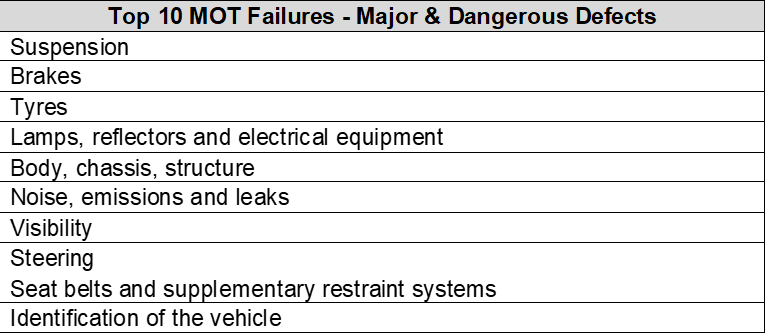
This marks a change from 2021/2022, when brakes and tyres were reported as the most common dangerous defects identified during MOT tests. With suspension now ahead of both categories in 2024 and 2025, the findings suggest it is becoming an increasing issue for motorists. **
Nonetheless, brakes and tyres remain among the most frequent reasons for MOT failure. The wearing down of brake pads, fluid leaks, and system failures is often to blame for brake problems, while tyre issues are generally caused by damage from road hazards like potholes and general wear and tear over time.
Last year almost one in five (18%) vehicles failed their MOT at the first test, with lamps, reflectors and electrical equipment, as well as chassis and structural defects also among the leading causes of failure.
Meanwhile, the findings also point to the impact of an ageing fleet, with the average age of cars in the UK rising to almost 10 years old. *** The rise suggests motorists may be keeping vehicles for longer amid continuing financial pressures, with older vehicles naturally becoming more prone to wear and tear and mechanical issues.
Indeed, DVSA data shows that vehicles aged 11 years and older make up the majority (61%) of failures, whilst those aged between six and 10 years old accounted for almost one in three (31%) MOT failures. ****
Yet, the data also suggests that younger vehicles are not immune from failure as more than half a million vehicles aged five years old and under failed MOT tests first time. Although vehicles under three years old don't legally require an MOT, the figures show that newer vehicles are not immune from failure and can still develop faults requiring attention.
There are penalties for driving with an expired or invalid MOT. Those who are caught driving a vehicle beyond its expiry date can receive a fine of up to £1,000, but in most cases it’s likely to be a fixed penalty notice of £100.
However, if the vehicle is found to have failed its MOT as a result of a dangerous problem, the driver can be fined £2,500, be banned from driving, or receive three penalty points on their licence. What’s more, driving without a valid MOT could affect insurance cover, which further shows the potential financial and legal impact of a missed test.
Co-op Insurance is therefore encouraging motorists to ensure that they take action on any issues that their vehicle has picked up as this could lead to increased bills for repairs, as well as safety issues. The member-owned business is also encouraging motorists to ensure that they have a valid MOT before driving.
Paul Evans, Head of Motor at Co-op Insurance said:
“While MOT tests are a legal requirement, they’re also an important opportunity for checking that your vehicle is in safe condition, reliable, and performing as well as it can on the roads.
“However, our data shows that 4.5 million major and dangerous suspension defects were identified during MOT tests last year, making suspension the most common reason for MOT failure.
“The rising average age of vehicles also shows that people are keeping them for longer, perhaps understandably as a result of cost-of-living pressures, but as they get older, there is a higher risk of safety issues or MOT failure, so it’s even more important that vehicles are regularly maintained.
“We’re therefore encouraging people to make sure that they don’t neglect any issues that their vehicle has picked up, as this could ultimately lead to higher repair costs and worsening safety risks. We also want to remind drivers that they must ensure that they have a valid MOT for their vehicle before driving.”
Find out more about Co-op Motor Insurance
-ENDS-
Notes to editor
Freedom of Information data obtained by Co-op Insurance from the DVSA
*Yearly volume of dangerous and major suspension defects

Most common reasons for MOT failure in 2025

Number of MOT tests 2025 - 42,515,983
Number of first-time MOT failures 2025 - 7,576,269
*** https://www.independent.co.uk/bulletin/news/new-cars-second-hand-uk-b2802760.html

About Co-op
Co-op Group is one of the world’s largest consumer co-operatives, operating across food retail, funerals, insurance and legal services. Owned by around 7.2 million active member-owners, Co-op exists to meet their needs and champion the causes they care about.
With more than 2,300 food stores, 800 funeral homes and a wholesale business supplying around 8,000 additional outlets, Co-op employs 53,000 colleagues and generates annual revenues of over £11 billion. It is a recognised leader in ethical business and community-led programmes, creating long-term value for members and communities across the UK.